
The stone furnace in George Rogers Park that Oregon's iron dream left behind
Built in 1866 to end the West's dependence on iron shipped around Cape Horn, the Oswego Iron Furnace outlasted its industry and is now the only surviving charcoal blast furnace west of the Rocky Mountains.
Along the riverbank in George Rogers Park, among the black cinders of a vanished industry, there are chunks of glass in sapphire blue, turquoise and green.
According to the Oregon State Historic Preservation Office, the slag left by the Oswego iron works ranges from solid, glassy pieces to frothy ones light enough to float.
Most of it is black, but not all.
That slag is a leftover of the Pacific Coast's first iron blast furnace.
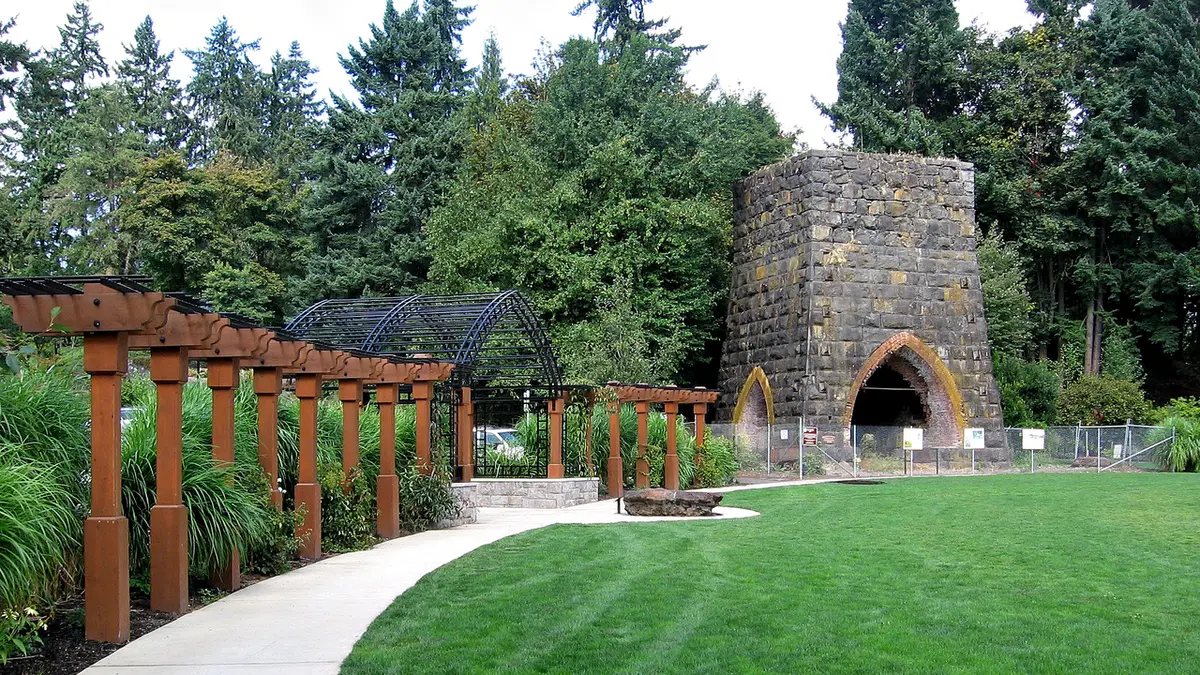
The furnace itself still stands in the park.
The Oregon Encyclopedia calls it Oregon's oldest industrial landmark and the only surviving charcoal blast furnace west of the Rockies.
The furnace was blown out for the last time on November 1, 1885, about two weeks ago.
Why Oregon wanted its own iron
Before 1867, the Oregon Encyclopedia says, nearly all iron on the West Coast arrived by ship around Cape Horn, a voyage it describes as hazardous and as long as 17,000 miles.
The state historic sites database gives the distance as 14,000 miles.
Either way, the trip took four to five months, and imported goods such as pig iron sold for up to ten times their eastern cost.
The discovery of iron deposits near Oswego in 1861 raised hopes that Oregon could supply the region itself.
The site had ore, timber for charcoal, a landing on the Willamette River, and waterpower from the outflow of what was then called Sucker Lake, now Oswego Lake.
The ore ran 44 to 54 percent iron.
The Oregon Iron Company was incorporated in 1865 by Portland merchants with interests in shipping, railroads, banking, real estate, and gas and water systems.
William S. Ladd was president.
The company hired 23-year-old George D. Wilbur of Sharon, Connecticut, to build the furnace.
He modeled it on the Lime Rock, Connecticut, furnace he had helped build for the Barnum Richardson Company.
According to the state database, it had the hallmarks of a Connecticut furnace: fine cut-stone masonry, Gothic arches and a barrel-vaulted flue in the rear wall.
Blown in, with high hopes
The furnace was "blown in" in August 1867, amid hopes that Oswego would become the "Pittsburgh of the West."
The Oregon Encyclopedia gives the first cast as August 24, 1867.
The state database mentions both August 24 and August 27, so the sources don't fully agree.
Workers fed charcoal, ore and limestone into the top of the stack.
Air was heated to about 800 degrees and blown in at the bottom.
The Oregonian reported that "the effect upon the burning mass of coal, ore and lime is something too fierce for description."
When the tap hole was opened, a stream of glowing iron ran down a channel into molds in a sand floor.
The resulting ingots are called pig iron because the layout of the trenches reminded workers of a sow nursing piglets, the Oregon Encyclopedia notes.
The original stack was 32 feet tall.
Historic sources disagreed about its dimensions, so the state database reports that measurements were taken during a 2009 restoration.
Its walls were built to withstand 2,800°F. In the winter of 1878–1879, later owners added 12 feet, making the stack 44 feet high.
The state database says the added stonework lacks the refinement of the original but, with improved blast equipment, doubled the furnace's productivity.
Photographer Carleton E. Watkins photographed the works not long after they opened.
A business that never quite worked
The industry struggled from the start.
According to the Oregon Encyclopedia, it was undercapitalized, skilled workers were scarce, and cheaper Scottish iron competed as import tariffs fell.
Charcoal was the most expensive part of the business, taking almost half the workforce.
By 1885 more than a hundred charcoal pits smoldered in the woods between Tryon Creek and West Linn.
The bankrupt Oregon Iron Company was sold at a sheriff's auction in 1877 to ironmakers from Ohio.
They formed the Oswego Iron Company, then sold in 1882 to Simeon G. Reed.
He became president of the new Oregon Iron & Steel Company, backed by financier Henry Villard.
Between 1867 and 1885, the original furnace produced 42,000 tons of pig iron, sold to foundries in Portland and San Francisco.
Reed had plans for a modern furnace half a mile north, and the old one was blown out for the last time in 1885.
Financing delays held up the new furnace until October 20, 1888.
In 1890 it produced 12,305 tons of pig iron, and the company employed over 600 workers.
Then came the Panic of 1893.
Dependence on charcoal and the cost of importing limestone from Washington State hurt the company, but the Oregon Encyclopedia says the fatal blow was the crash.
Oregon Iron & Steel was one of 14,000 businesses that failed.
A separate Oregon Encyclopedia entry says the furnace closed in 1894.
The company's pipe foundry kept making water pipe until 1928.
The survivor
The pipe works and the ironclad furnace were dismantled in 1929.
The old furnace survived, the Oregon Encyclopedia says, because its stonework defied demolition.
The city of Oswego bought the original furnace site for a park in 1945.
The furnace was listed on the National Register of Historic Places on February 12, 1974.
After concerns about its condition, the city formed a Furnace Restoration Task Force.
Work to preserve and stabilize the stack was completed in 2010.
The furnace is now the centerpiece of the Oswego Iron Heritage Trail.
Some of what you see is not original.
The state database says the firebrick lining inside the stack is gone, probably removed so the bricks could be reused.
As a result, visitors can walk through the arches into what was once a closed chamber.
The chimney and heat exchanger on top are gone too.
At the base is a lump of solidified iron fused to bricks, which ironworkers called a "salamander" or a "bear."
Two more salamanders found on the riverbank were moved near the furnace in 2005.
By the late 20th century, bricks had fallen out of the flue high on the northeast wall, and barn owls had been using it as a roost.
During the 2009 restoration, the remaining bricks blocking the flue were removed.
Its ends now have acrylic covers to keep the owls out.
Archaeologists also found two brick-walled channels running toward the casting arch and the east tuyere arch, capped with crude cast-iron plates.
When one plate was lifted, there was only clean sand inside.
The state database says their purpose is unknown.
From iron town to lake suburb
The iron dream failed, but the company's owners kept their land.
After 1910, the Oregon Encyclopedia says, Oregon Iron & Steel began developing Sucker Lake and the land around it, marketing it to prosperous Portlanders as a recreational haven.
By the 1950s, the company's owners had turned the property into one of Oregon's most valuable residential locations, Lake Oswego.
The iron also lives on in Portland, where the Oregon Encyclopedia says the company owners' cast-iron buildings preserve its legacy.
Sources
This story was written with AI assistance from the public sources listed above. Spot an error? Email [email protected].