
The 626-foot tower south of Hillsboro that sent telegrams to ships and Asia
From 1921 to 1952, a giant steel radio tower balanced on a ball-and-socket joint rose south of Hillsboro, run by operators who sat in downtown Portland.
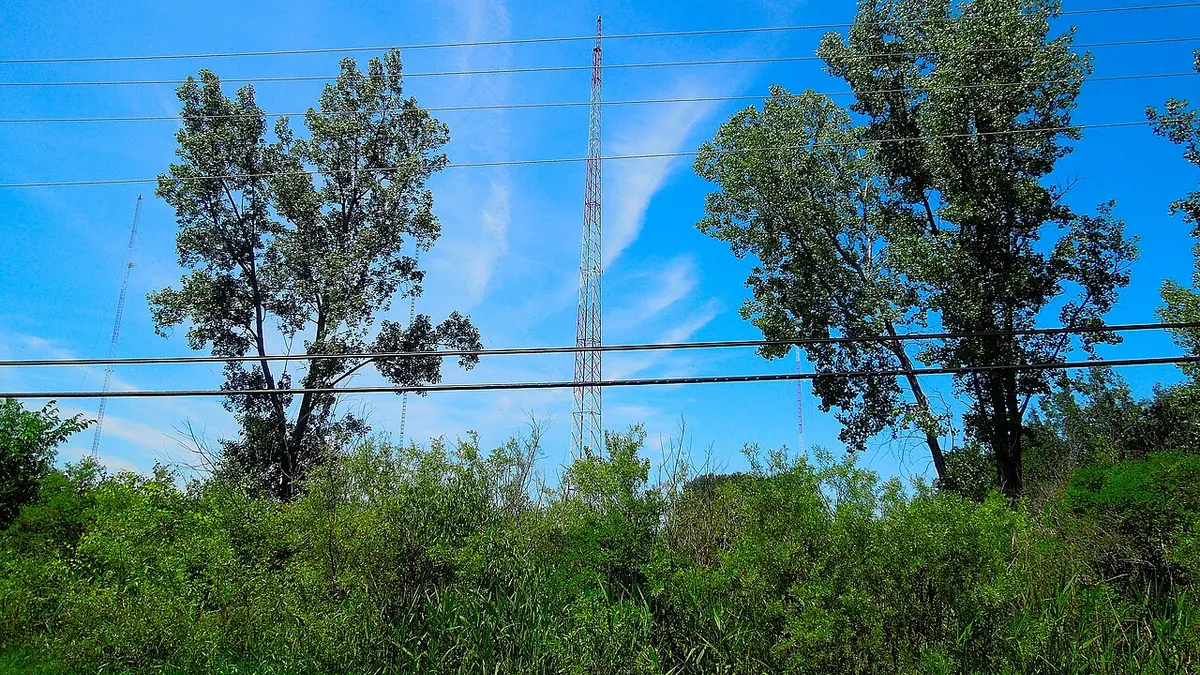
The tallest structure on the Pacific Coast did not stand in Seattle or San Francisco.
For three decades it stood on land south of Hillsboro, and it rested on a ball-and-socket joint at the ground.
Its engineers described a latticed steel shaft, six feet square, rising from that joint.
Five sets of steel cables, tied to massive concrete anchors, held it upright.
That was the Hillsboro wireless tower, a 626-foot landmark that carried telegraph traffic to ships at sea and, according to the sources, as far as Asia and Europe.
It went up in 1921 and came down in 1952.
As Hillsboro marks its 150th year, it is one of the city's least-remembered giants.
Why build it here?
The Federal Telegraph Company, which had its factory in Palo Alto, had operated radio stations along the Pacific Coast before World War I. When the U.S. entered the war in 1917, the Navy requisitioned them.
Haraden Pratt, the company's acting chief engineer, wrote in Pacific Radio News in February 1921 that much of the equipment was bought by the government and in some cases removed or altered.
After the war, Federal was not in a position to go back to radio for its coast-wide telegraph business.
The company then arranged to build two new transmitting stations, one near Portland and one near San Francisco.
Pratt described the Portland site as a tract bordering the Tualatin River, near Hillsboro and about 18 miles from Portland.
According to Wikipedia, which cites a 1920 Oregonian report, Federal bought the property on September 20, 1920, from the Fred Rood estate.
It paid $41,500 for 331 acres, then about three miles from Hillsboro.
(The same article elsewhere rounds the site to 330 acres.)
Wikipedia also says the tower replaced one the federal government had owned in Lents.
Under that account, the government removed the Lents tower and sent it to Siberia during World War I. That detail comes from a single secondary source here.
A tower, eight satellites and an umbrella
Pratt's article describes an "umbrella" antenna about 3,000 feet across, with its center supported at the top of the tall tower.
According to Wikipedia, the site had eight shorter towers arranged in a circle around the central one, each 1,500 feet from it.
The main tower's cables were an inch and a quarter thick.
Workers dug concrete bases 14 feet deep under engineer J. L. Miller.
Wikipedia puts the total cost at $300,000.
A large concrete building, 60 by 80 feet, stood on the grounds.
The station was run remotely.
Pratt wrote that operators in Federal's Portland offices would control two transmitters at the Hillsboro site.
Because there would be two receivers and two transmitters, messages could go out and come in at the same time, a setup he called quadruplex operation.
Wikipedia adds that a receiving set was installed atop the Board of Trade building in Portland, with transmission lines linking the offices to Hillsboro.
Second-tallest in the world?
The tower was billed as the world's second-tallest steel tower, behind only the Eiffel Tower.
The sources are not perfectly tidy on this.
Wikipedia makes that claim, then says that once complete it was the tallest structure on the Pacific Coast and that the only taller structures in the world were the Eiffel Tower and New York's Woolworth Building.
Both statements can be true if the Woolworth Building, an office tower, is counted as a building rather than a steel tower.
The 1921 Pratt article does not make a ranking claim.
The station, with the call letters KGH, was dedicated on May 11, 1921.
Wikipedia, citing a 1976 Hillsboro Argus article, says 500 people attended, including Hillsboro Mayor A. C. Shute.
What kind of transmitters?
The sources disagree on the equipment.
Pratt wrote in 1921 that the stations were being fitted with Federal arc radio transmitters.
Wikipedia says KGH used synchronous rotary spark-gap transmitters, a 3-kilowatt set for nearby ships and a 5-kilowatt set for ships far out at sea.
It adds that Mackay later replaced one spark-gap unit with an arc-and-tube type.
The Maritime Radio Historical Society, which says Mackay owned the station, says KGH used arc emission on three low frequencies, plus 17 other frequencies in the high-frequency bands using A2 emission.
The plans and the equipment actually installed may have differed, and these sources don't settle it.
A companion station, KEK, began operating on July 9, 1923.
Wikipedia says it was licensed to Hillsboro but housed in a building on Council Crest in Portland.
It received ship traffic and relayed it to the main office in the Postal Building downtown.
Wikipedia quotes The Oregon Journal in 1923: "Portland is one of the very few cities in the world that has a complete ship to ship and point to point radio service.
KEK receives news day and night of ships carrying loved ones, news of ships in trouble.
Vessels 1,000 miles at sea report their positions nightly or might request medical aid."
New owners, a strike and a quiet end
In September 1927, according to Wikipedia, the Mackay Radio and Telegraph Company, a subsidiary of International Telephone & Telegraph, bought KGH.
Mackay added a shortwave transmitter.
In 1929 it put a more powerful transmitter into use, which the company had said would make KGH the most powerful marine radio station in the Northwest.
In October 1935, an employee strike silenced the transmitter.
During World War II the federal government took over operations, and the Coast Guard ran the station.
In 1951 the station was abandoned, and the tower was torn down in 1952.
What remains
The sources describe no marker or surviving structure.
Wikipedia places the site adjacent to what is now Meriwether National Golf Club, south of Hillsboro.
The tower's story is preserved in newspaper archives, a 1976 Argus retrospective, and at least one photograph, captioned "The tower near Hillsboro with airplane showing scale."
Sources
This story was written with AI assistance from the public sources listed above. Spot an error? Email [email protected].